
We believe in a world powered by EECS Engineering, sustainable energy. We are dedicated to providing innovative solutions that keep homes and businesses running.

Get A Quote
Contact Us

+1 202-579-9775

info@eecs.us

9500 NE 19TH AVE VANCOUVER, WA 98665

Follow Us

Education: EECS Automation & Electrical Engineering Training Programme

Education: EECS Automation & Electrical Engineering Training Programme
  • Oct 9, 2026
  • Admin
  • 2 min read

Education: EECS Automation & Electrical Engineering Training Programme

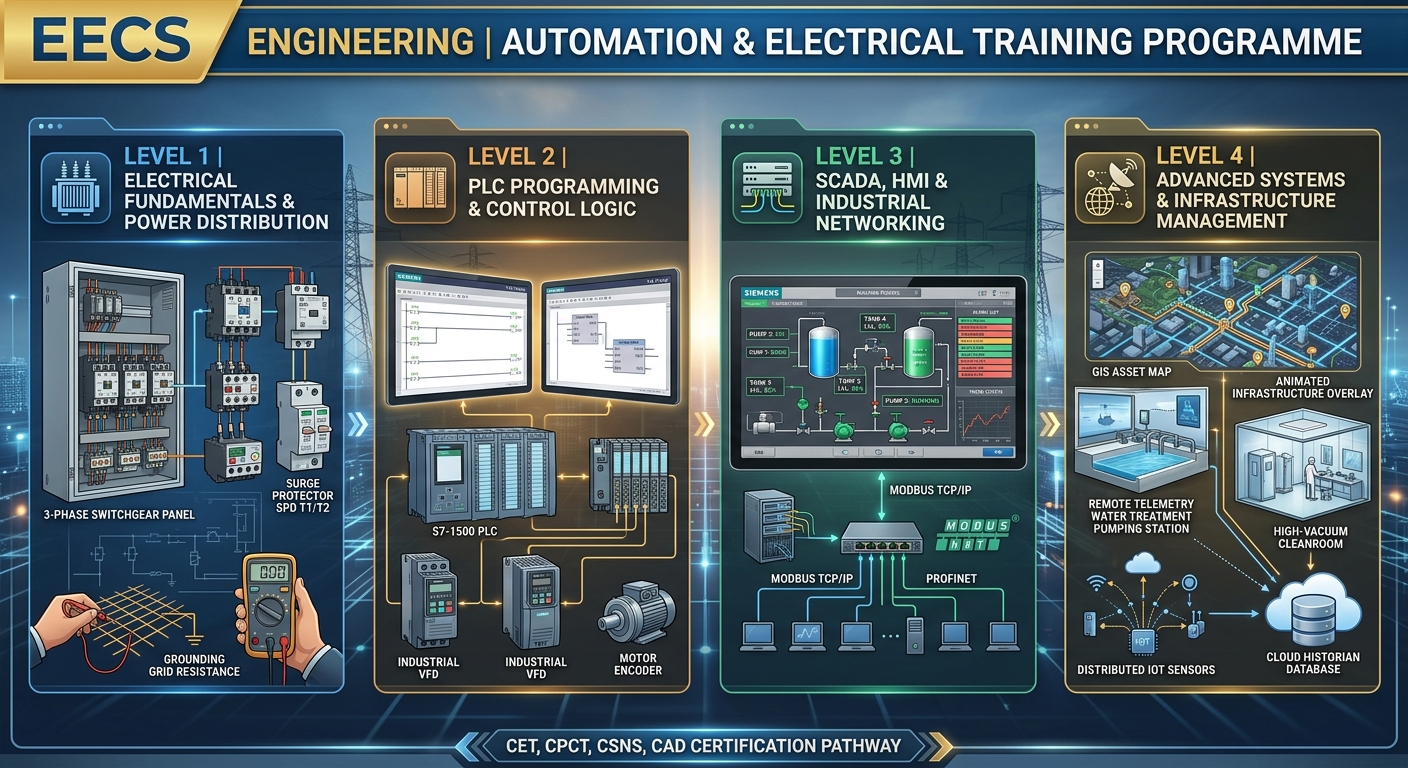
Explore our 4-level certification pathway and get certified by EECS Engineering:

    Enrollment for upcoming class is now open through EECS Engineering.

      Level 1: Certified Electrical Technician (CET)

        Level 2: Certified PLC Control Tech (CPCT)

          Level 3: Certified SCADA Specialist (CSNS)

            Level 4: Master Infrastructure Lead (CAD)

            Foundational Electrical Systems & Safety
            Prerequisite for control logic training
            1.Foundational Electrical Systems & Safety:Prerequisite for control logic training.

            Focuses on schematic reading, control transformer sizing, short-circuit protection, earthing grid measurement, and cabinet wiring standards. Hands-on labs involve troubleshooting simulated panel faults and calculating breaker/conductor capacities.

            Programmable Logic Controllers (PLCs)
            Core automation module
            2.Programmable Logic Controllers (PLCs):Core automation module.

            Covers core programming paradigms across major hardware environments. Trainees learn to configure remote I/O racks, structure main program loops with interrupt routines, and execute analog signal scaling (4–20 mA, 0–10 V) for industrial sensors.

            SCADA Systems & Telemetry Integration
            3.SCADA Systems & Telemetry Integration:

            Covers real-time data acquisition, building custom HMI dashboards, setting up trend charts, configuring historical data logging, and integrating field telemetry with central monitoring stations.

            Specialized Infrastructure & Applied Field Engineering
            4.Specialized Infrastructure & Applied Field Engineering:

            Applies learned techniques to real-world infrastructure problems: automated municipal water/pumping stations, dynamic grid transformer monitoring, and high-precision environmental control loops.

            Share: